
Use Cases For Power Stations – Plus Review of The Ecoflow River
Portable power stations have been growing exponentially in popularity, and for good reason. They provide added utility beyond what a smaller external battery pack offers, in that they typically include AC and DC power outlets and power devices that are much more power-hungry. Depending on the combination of the total power station capacity you choose and the devices that you need to power, you could potentially be set for a couple of days off-grid.
Find it online:
- EcoFlow River (288Wh): Check Price
- EcoFlow River Max (576Wh): Check Price
- EcoFlow River Pro (720Wh): Check Price
Why They’re So Popular

Traditionally, off-grid power meant that you had to use a gas-powered generator which is both heavy (at lightest around 50lbs) and noisy – especially when used at a quiet campsite. Other requirements include the actual gas, light maintenance in the form of routine oil changes, and keeping proper safety distance from the exhaust. With battery power stations, all you have to do is charge it up via wall socket, solar power, or in your car while driving and you’re good to go.
One drawback of a battery power station is that they generally cannot power the more demanding appliances that their gas counterparts can, however, that’s a non-factor for the vast majority of the target market. For many of us, we simply need multi-day power for mobile devices such as phones, laptops, and cameras – and a battery power station is perfect for that use case. Another benefit is in the weight and space savings, typically weighing a fraction of gas generators and about the size of a lunchbox. Plus, as mentioned earlier, no gas or oil to deal with!
What Is The EcoFlow River

The EcoFlow River started as a Kickstarter project and claimed to have a unique feature called X-Boost: which diverts the power from all 3 of its AC outlets (up to 600watts each) to a single one, providing up to 1800watts for certain more demanding appliances such as a hot plate or a coffee maker (for when the caffeine withdrawal starts hitting hard).
Main Features

Aside from the EcoFlow River’s hat trick, another great feature is its modularity. The main unit has a capacity of 288Wh and an available expansion battery that seamlessly attaches to the bottom of it with 4 screws that double the total capacity to 576Wh, while only adding 5.5lbs. This means that on those shorter day trips where you only need light energy needs, you can save some weight in your kit and only bring the main unit (around 11lbs). Overall package size is around (in inches) 11.3 X 7.3 X 7.7 – with the expansion battery increasing the height dimension by 2.3 inches.
The expansion battery also adds a strip of LED lighting to your power station, if you’re into that sort of thing.
All of EcoFlow’s power stations have quick charge via the provided AC cable. In the case of the River model, it can fully charge the main unit from empty in a little over 1.5 hours. With the expansion battery, roughly double that. Other charging options include solar (up to two 110W panels) and DC charging while you’re driving to your destination.
Easy-to-read Display

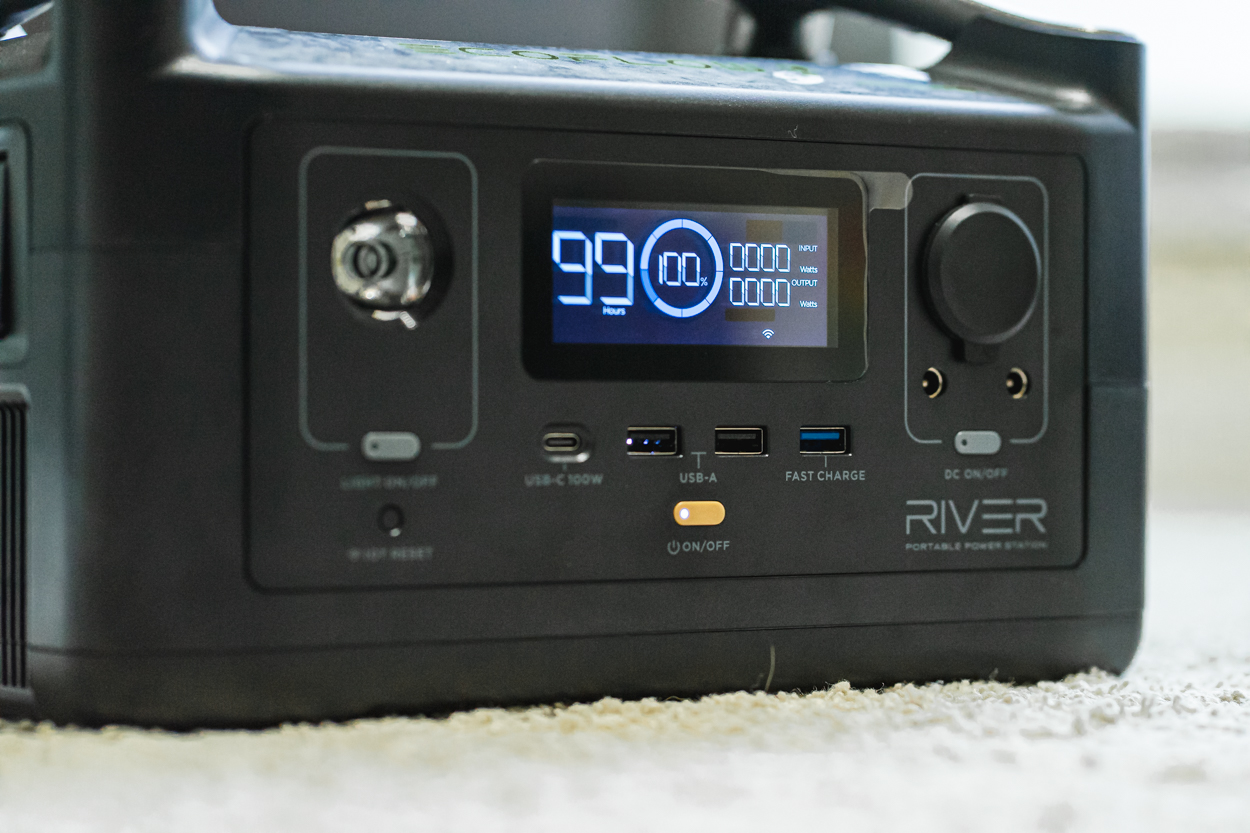
One of the best features in my opinion is the informative display – it will show you the current power input/draw, total use time left based on the said draw, and current remaining battery life. It’s a color on black background LCD, which makes it easy to read even in daylight.
Additional Ports

Other charging ports that are on the River include a PD USB-C (100watts) for compatible laptops, 2 regular speed USB-A, and one fast charge USB-A.
Emergency Light

There is a built-in light that has a low/high mode, as well as an SOS mode. This can be useful when you need to plug-in devices or to catch someone’s attention if your rig breaks down in the dark.
How Does it Work on the app?

Finally, there is the EcoFlow app – which allows you to monitor the device’s power levels and manage its settings over Bluetooth. The app is also needed to enable/disable X-Boost high wattage mode, which unfortunately is the only way to do so.
How To Use

Using this power station is pretty straightforward – turn it on and plug in your device of choice. All of the USB ports are always on, whereas the DC and AC ports have dedicated buttons to enable their use. This is likely to save power, as the use of the AC ports turns on an internal fan to keep the circuitry cool.
Real-Life Scenario

My family and I recently experienced a power outage that lasted around 18 hours, and this device proved its weight in gold. I decided to plug in the modem and router to keep the internet alive in our house due to having a poor cell signal. With an average power draw of around 10-12watts, the display showed a total run time of about 28 hours. This meant that I had plenty of juice to also keep our phones charged and the white noise machine going for our baby. Keep in mind, however, these numbers are only for the main unit.
With the addition of the expandable battery mentioned earlier, you can expect double the usage. For shorter outages of a few hours, we also use this device to keep the refrigerator and deep freezer running at temp.
What’s Included

- EcoFlow River Unit
- AC Charging Cable
- DC Charging Cable
- MC4 to XT60 Solar Charging Cable
- DC5521-DC5525 Charging Cable
Overall Impressions
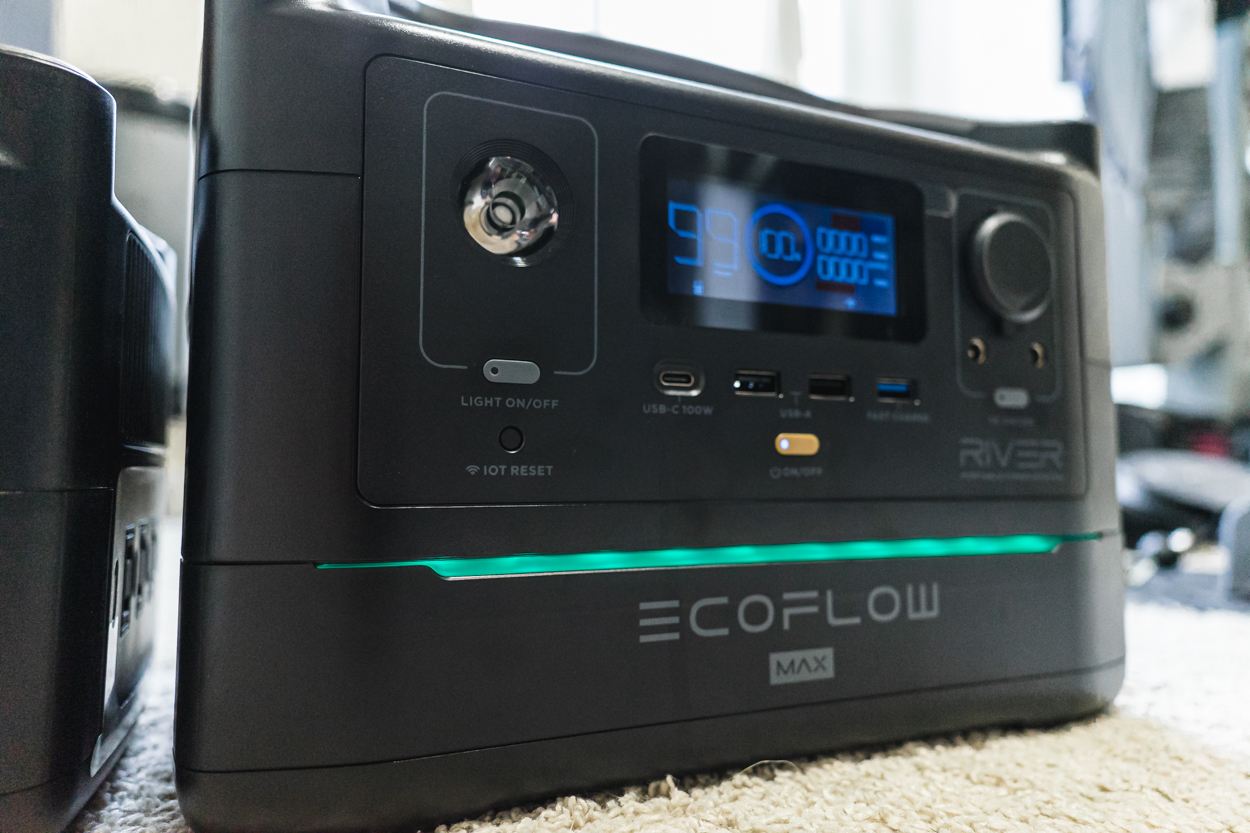
I purchased the EcoFlow River last year with my own money, so this review is unbiased. I couldn’t be happier with my purchase as I’ve gotten some crucial use out of it. I am aware of the competitors in this space, but couldn’t ignore the value proposition that EcoFlow presented (plus I’m a techie, so they win in that space). This is a solidly built unit, and I like the ability to take off the expansion battery when I don’t need a ton of power and weight savings is the priority.
Let me know your thoughts on this relatively new offering from EcoFlow, and which power stations you trust on your excursions in the comments!

Can this thing be used to charge devices while it is being solar/wall charged at the same time?
Would like to hear long term experience as Amazon’s reviews are not that great for this unit about charge retention and parasitic drain.