

Have you ever wondered if there is an easier, faster, and cleaner way to drain your oil? If you are like me and perform your own maintenance, this was a question I’ve asked even before owning the 4Runner.
With a normal oil change, you pull the drain plug and hope not to have oil splatter everywhere. Even with a large oil pan, this can be a challenge. Those days are over with the Fumoto oil drain valve. This was one of the cheapest yet also one of my favorite mods that I’ve added to my 4Runner.
The Fumoto oil drain valve is a small brass valve that threads into your previous drain plug location. It comes with a lever to shut the oil flow on and off. To prevent the accidental oil drain, the lever locks into place with a tough plastic guard. To make things even better, the company offers a hose kit that connects to the valve so you can direct the oil exactly where you want it to go. I mean, come on, it doesn’t get any better!
Find It Online:
- F133:Check Price
- F133S w/Hose Kit:Check Price
Table Of Contents
Fumoto’s Background

Fumoto has been around since 1976, making valves for various applications and vehicle companies. Some of the largest companies, including Toyota, have even granted genuine parts status in Japan and the United States. Stateside, they supply companies like Cummins, Caterpillar, Peterbilt, and many others. With trust like that, you know you are getting a quality, well-built product.
The valve itself will not open on its own. The lever locks in place and comes with a clip that can only be attached when the lever is in the locked position. It is double-sealed from both sides to prevent leaks. Construction consists of a forged brass body with stainless steel internal components. To top it off, you get a lifetime warranty.
Installation

The tools and supplies required to do this would be the same as those required to change your oil. The only added tool would be a crescent wrench to tighten the valve to your drain pan. There is no need to get a new gasket; they provide one when purchasing the valve.
Tools
- Crescent wrench
- 10mm, 12mm, and 14mm sockets and ratchet
- Torque wrench for oil filter(9- 18 ft-lbs)
- Ratchet extensions as necessary
- 64.3mm Oil Filter wrench (if doing an oil change)
Supplies
- 0W-20 Oil of choice
- Toyota Oil filter kit (if doing an oil change) P/N: 04152-YZZA5
- Fumoto valve
- Rags
- Hose kit (optional)
You don’t have to purchase the hose kit, but it is a really nice thing to have, and it only costs $6. Without the hose kit, the oil will still come out of the valve in a cleaner, way less messy fashion than without the valve. I personally love being able to direct the flow of oil so you can have the oil container in a different location out of your way while you work.

I don’t know if I would claim this to be a “process”; it’s too easy. The only pitfall to this installation is that you would need to initially pull your stock drain plug for your oil pan in order to install the valve. I recommend doing it when you have to change your oil; that way, you can do it all at once. Plus, you get to test out the product, which is awesome.
Step 1. Pull Off Skids

Remove your front and center skid using your 10mm and 14mm sockets. Pulling off the center skid will make installation easier. I also like to inspect as many components as possible when doing maintenance.
Step 2. Replace Stock Drain Plug
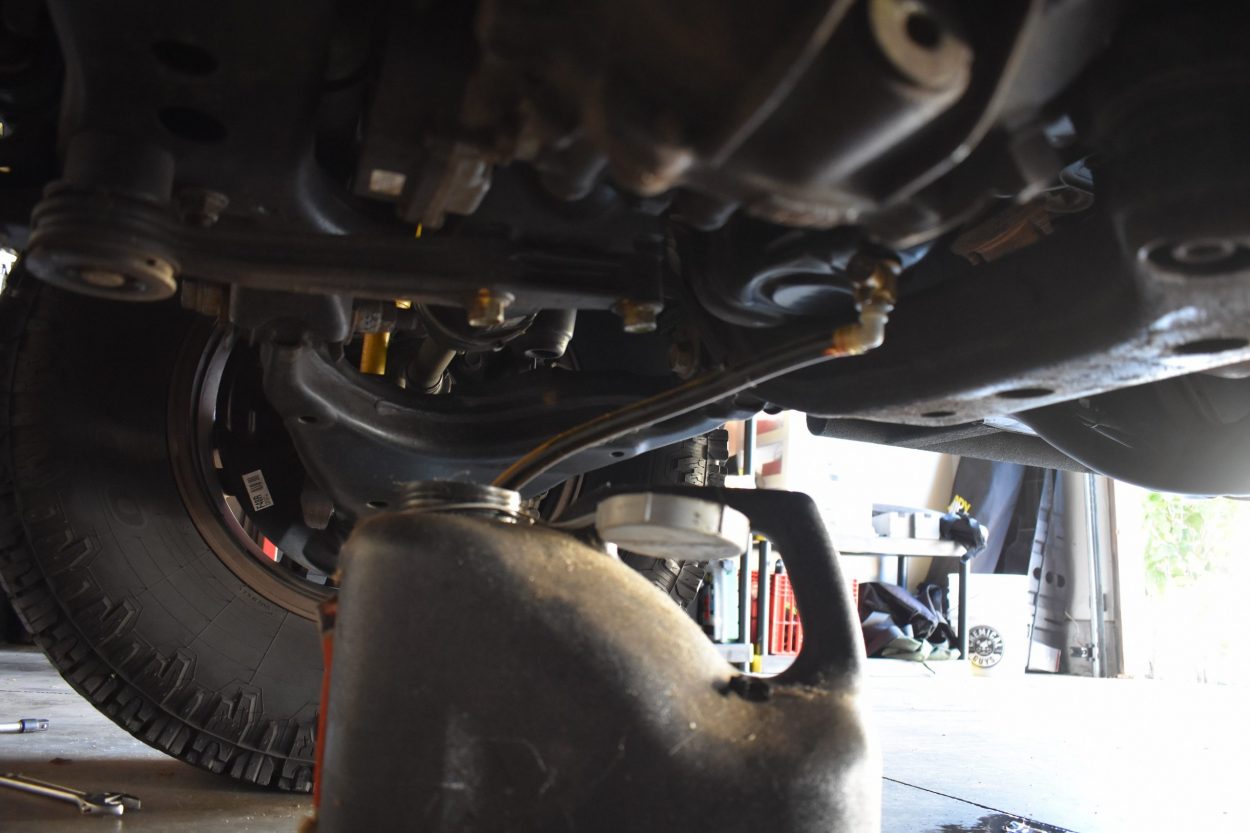
Personally, I wanted to use the valve upon installation, so I installed the valve they connected the hose to test it out. Just quickly pull out the OEM drain plug and install the Fumoto valve. Then, complete the rest of your oil change with ease. If you are not down to swap over really fast, just drain your oil as normal and install the valve after the oil has drained.
Step 3. Tighten The Valve

Fumoto recommends installing the drain plug hand-tight and then using a crescent wrench to tighten it a 1/4 turn more. Do not overtighten! For reference, the stock drain plug torque is 30 ft-lbs.
Step 4. Leak Check

Once you have either completed an oil change or installed the valve, ensure you have no leaks before installing your skids.
Step 5. Put New Oil

Continue with the remainder of your oil change as normal. Even if you didn’t completely drain your oil to install the valve, you’ll likely need to top off your oil after what was lost when removing the original oil plug.
When installing the oil filter, the filter drain cover is 9 ft-lbs, and the housing is 18 ft-lbs. When finished, don’t forget to install the locking clip over the lever. Then install your skids. It probably won’t hurt to add a splash of oil if you lost any while swapping over to the valve.
Real World Testing

The valve has held up flawlessly against the elements and many oil changes. One of my main concerns was the valve being able to come unlocked somehow, but with the clip installed, it doesn’t seem possible. Then again, my next concern would be the locking clip falling off, getting bumped off, or getting washed away. I still have the same clip on the valve from when I purchased the kit, so don’t worry about the locking clip.
After seven oil changes and approximately 45,000 miles, there isn’t anything I can complain about. There aren’t any leaks, and the hose kit I purchased for $6 has held up as well. I do recommend trimming the hose to your desired length as it will make it helpful during oil changes, especially when underneath the vehicle that isn’t on jacks or ramps.
The only way I could foresee something happening to the valve or its components would be landing very hard on your skid, where the valve sits. I have stock skids and have had zero issues, but it wouldn’t hurt to have aftermarket heavy-duty skids if you are worried about landing directly at the valve.
Final Thoughts

Overall, I love this product and recommend it to all vehicle owners who perform their own maintenance. Fumoto’s website allows you to search for the vehicle you want a valve for. The price of everything together is $36, so it’s hard to turn down. Next time you are coming up on your oil change, just spend a little extra and thank me later.
I don’t mind performing my own maintenance. Most of the time, I enjoy turning a wrench. However, when it came to oil changes, I was tired of trying to soak up oil messes on the ground and on undercarriage components.
With the Fumoto oil drain valve, I look forward to how easy it is to change oil without making a splattering mess and coating my hands in oil. Now I can unlatch a lever and walk away knowing zero oil is getting anywhere besides my catch can. Save the time and mess, and go grab one of these sweet valves for your future oil changes!

Hi, Fumoto is a proven product that I have used for years in the class A trucking world. If it’s used on semi trucks in the industry running 200k miles a year thru out this country in rain, sleet, snow and ice it should be no worries in our passenger vehicles. It makes draining oil a breeze, especially if you have full skids. The hose is a must have and i got the long nipple so the hose is secured on. I have rci skids and comes with a hole to drain but without the fumoto it creates a mess everytime with oil running off the entire length of your skids. I prefer not to use the safety clip as I’ve never had issue with it opening. The only way it’ll open is if you sheer it off.
Been thinking about doing this upgrade. The only thing stopping me is, when you pull the stock drain plug the oil has a clear shot at getting out of the pan. If the valve sticks above the pan bottom at all, you’re left with a small puddle in the bottom of the pan. Not a big deal unless there’s some debris in the pan that now can’t get out. Probably over thinking this. Have you ever checked to see how far the valve extends into the plug hole? Thanks.
I see what you mean, and I never considered that. With the way the valve is designed I’d imagine that there would be a small amount of oil left in the pan along with possible debris. The threads on the valve might be a little shorter than the stock plug. It makes sense to want to see if there was debris in the pan. What you could do if you were considering buying a valve would be to drain the old oil first, then every oil change after it has drained, pull the valve off to check. Or just pull the valve every 2nd or 3rd oil change, just to check. On my next oil change ill pull mine to see if there is anything, I’ve not pulled it off since I installed it.
So if you pull the valve off 30% or more of the time, why use it at all? And why use something that could be a possible failure point for keeping oil in your engine? I just don’t see any advantage in this.
I never pull the valve off, that’s up to you. I personally am not worried about it. The value in this for me is the ease during maintenance, and I’m not worried about it being a possible failure point. If you don’t see the advantage or are concerned about it failing then you don’t have to get one.
Just curious if you ever pulled off the valve to check for debris and found anything?