
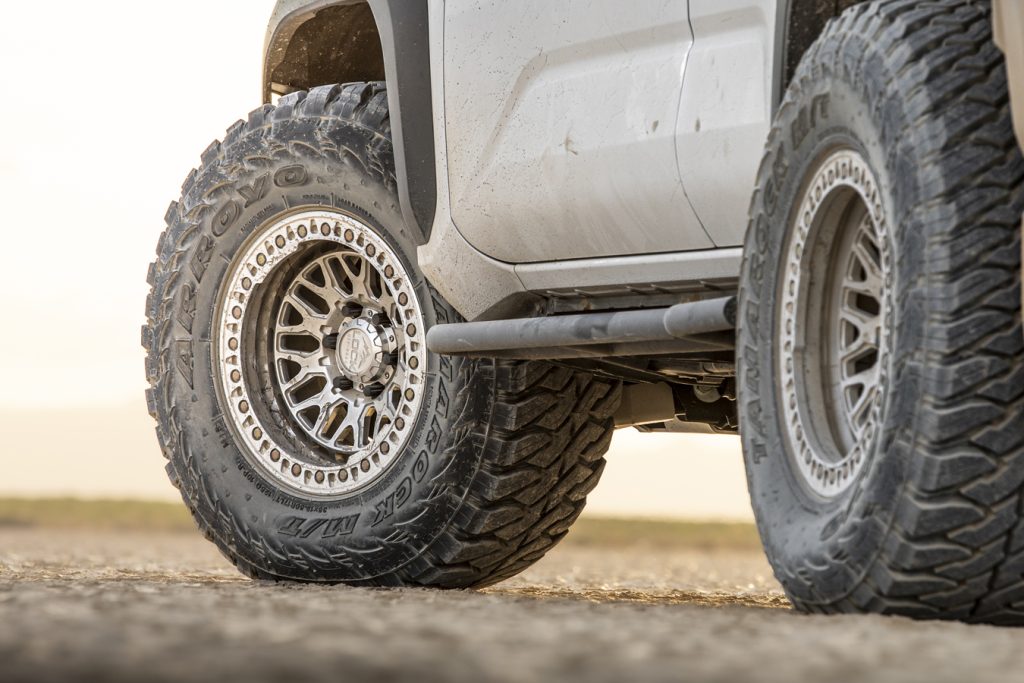
Goodyear made the first air-filled truck tire in 1916; before that, tires were solid rubber. In 1931, DuPont invented synthetic rubber, revolutionizing the manufacturing of automobile tires. Tubeless (air-filled) tires, which had been patented earlier, became commercially viable and available for trucks in 1955.
These are significant milestones in the history of tires in the United States. I think we’re living through another milestone… right now. But for whatever reason, most people are ignoring it. In the last 10 years or so, the technology and innovations implemented in wheel and tire manufacturing have revolutionized its most important characteristic, weight.
Table Of Contents
The Use Case For Reducing Weight
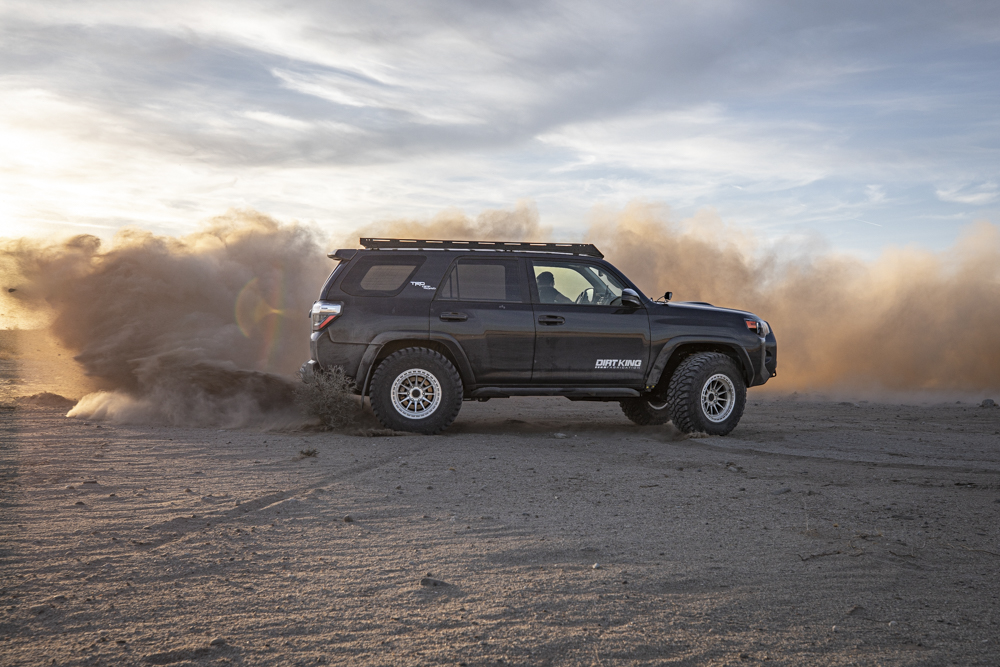
If you’re reading this, you know most Toyota enthusiasts likely don’t roll with the stock wheel/tire setup for very long. But for whatever reason, they don’t prioritize weight with their new wheel/tire decision. Consider this scenario… the 2023 Off-Road Premium comes stock with a 265/70R17 passenger-load tire for “fooling people on the test drive,” and it is pretty worthless off-road. The OEM wheel, which is 17 inches tall by 7.5 inches wide, weighs 31 pounds.
So, the smart and logical decision should be that, since you’re gonna gain some weight by buying a legit all-terrain tire, you should try to save some weight on the wheels… right? But almost no one does.
Race Cars and trophy trucks have been prioritizing weight savings ever since they started racing. Exotic supercars, for example, are made out of Kevlar and carbon fiber. Ford introduced carbon fiber wheels for the Mustang GT350. All in an effort to improve the vehicle, to go faster, to win the race. And as Reese Bobby said to his legendary son, Ricky, “If you ain’t first, you’re last.”
The fact remains that now is the time 4Runner/Tacoma/Tundra enthusiasts can legitimately take advantage of these wheel/tire weight-saving technologies, as they have finally made their way down to the Average Joe consumer. But some people are still stuck in the past… and I think it’s because they want to look cool.
Before I cast a wide net of criticism and disparaging remarks toward my fellow enthusiasts, I’d like to offer a Public Service Announcement on prioritizing weight when purchasing your next set of wheels/tires.
I also sought out an industry expert and had the privilege of interviewing Ian with WTD (Wholesale Tire Distributors – they’ve been in the industry for 40+ years). Ian shared some fascinating insights on wheels and tires with me and helped clarify things about wheel/tire technology, from manufacturing to the urban legends surrounding tire factories.
Evolution Of Tires
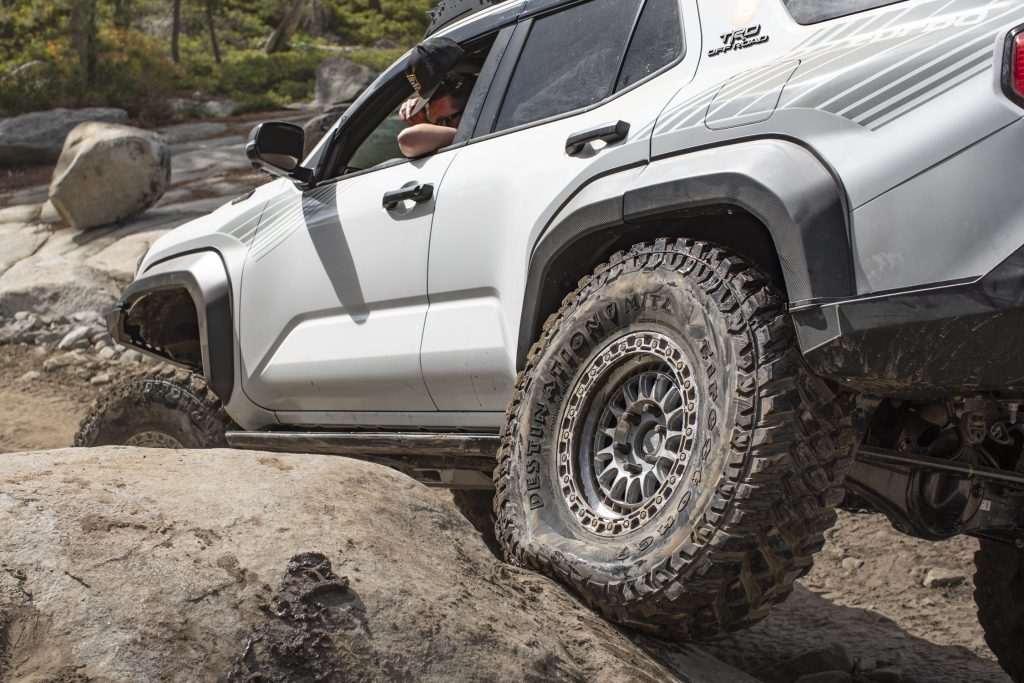
Tire manufacturing has improved tremendously over the last 10 years, mainly due to improvements in soft rubber composition. The softer rubber allows for deeper tread blocks, improving all-around traction (dry, wet, snow, gravel, mud). These compounds create not only a lighter tire but also a quieter tire.
So, this new tire material is now softer, lighter, has better traction, and lasts longer…. Is it too good to be true? Well, speaking of truth, it does get better. All of these combined improvements also provide a more balanced, “true” or rounder tire. Meaning they take much less weight when finally balancing a wheel/tire on a Hunter Road force, which prevents the famous steering wheel wobble. And the other main kicker to ease concerns about the term “soft” when it comes to tires is that almost every tire manufacturer now offers some type of warranty, which was almost unheard of 10 years ago.
For those a bit older like me, we used to have to sipe our tires for better tread life and traction in snow and ice. The local tire shops would do this for an additional fee, but they never really loved it, as it extended the tire’s life immensely, as the sipes increase heat dissipation in the summer. Almost all shops stopped doing it at the tire manufacturers’ demand, but nearly all tires now have much better siping than tires from even 5-8 years ago. Mileage warranties replaced the need for siping from the local tire shop.
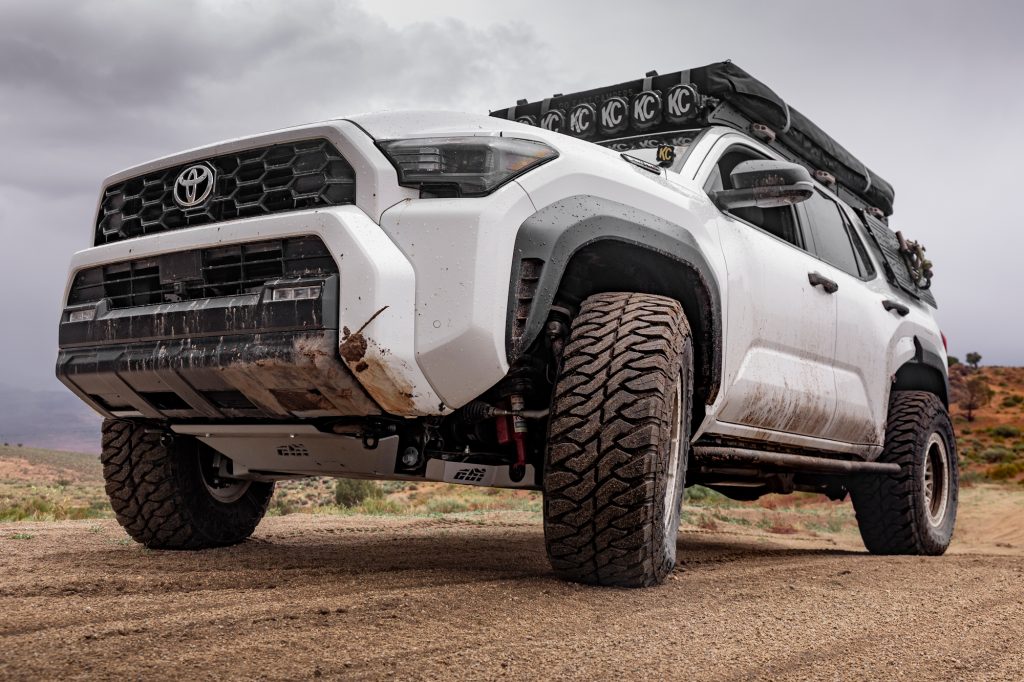
One wrinkle in the improvements in modern tires is that many 1/2-ton truck owners want a tire with better sidewall support. Modern trucks have never been heavier and are only getting heavier with the addition of hybrid batteries. I’m also guessing that if you’re an enthusiast who found your way to this article, you’ve probably added significant weight over stock in the form of racks, bumpers, lights, etc. And if you’re an enthusiast that tows a trailer or boat… even more reason to get a thicker sidewall. But please know, a thicker sidewall means a heavier tire.
So while the tires can save weight with their innovations, they’re adding some weight back with more sidewall. So is that a wash then? Not if you’re smart about it.
Most 4Runners and Tacomas don’t need the sidewall thickness of a Tundra. For example, one of the most popular all-terrain tires over the last 7 years for the 5th Gen 4Runner from a very well-known brand had always had a 2-ply sidewall. That same company then introduced an updated version of that tire, which now has a 3-ply sidewall. I will let you do the math as to which version weighs more. If you have a 4Runner or a Tacoma, you can likely take advantage of the weight savings of a 2-ply tire, since a 3-ply might be overkill.
Ian shared additional insights on tire manufacturing: only the oldest and “top premium” tire brands have their own proprietary factories, and as a result, they are better protected by their secret recipes for their chemical tire compounds. Those “top premium” brands make up less than 10% of the entire tire industry; therefore, there is a giant “copy-cat” formula that is industry-standard for almost 90% of the industry.
For example, let’s say a great truck tire is released that performs exceedingly well given its price point. It’s only a matter of time until the rest of the industry “copies” its formula and releases its own version of that tire very soon. My point being, and this is confirmed by Ian, who is an industry insider, now there are really great lightweight tires that come with a warranty, that can also be very reasonably priced.
Wheel Technology

Historically, wheels have also been manufactured and sold to the average consumer in one of two forms: cast and forged.
Cast wheels are made by pouring molten metal, typically aluminum, into a pre-shaped mold, which then solidifies into a desired wheel shape. They are generally very cost-effective and priced reasonably.
Forged wheels are made with a solid block of aluminum that is heated to a malleable state and then subjected to thousands of tons of hydraulic pressure in a mold to form a wheel shape. They have historically been priced at a premium, especially compared to cast wheels, because manufacturing has always been labor-intensive and expensive.
However, the premium has always been warranted and justified, as forged wheels are 3 times stronger and, on average, 25% lighter than cast wheels. Hence, the reason anyone involved in car/truck racing of any kind has always gone with a forged wheel.
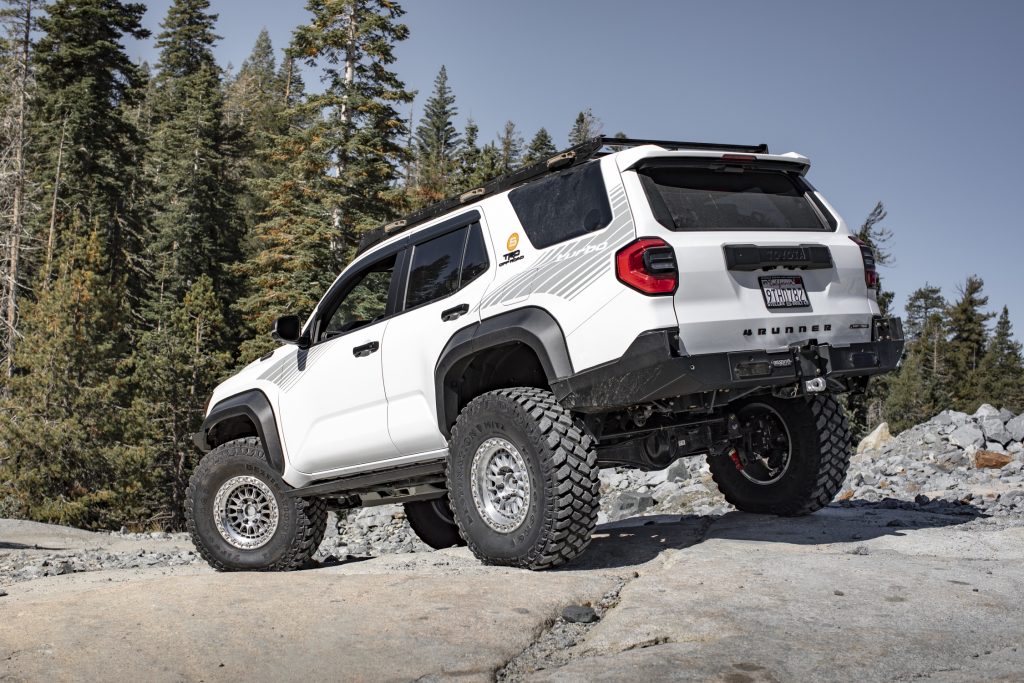
- Check out the Lock Off-Road Invader Wheels. A true, completely forged and beadlocked option.
Then, in the late 90s, a manufacturing technology known as Flow-Forging or Flow-Forming originated in the aerospace industry.
Flow forged wheels are created through a hybrid manufacturing process that combines the two methods: beginning with a cast wheel form, which is then spun at high speed and high heat and pressure in the inner barrel, stretching it to a desired final form. The final product is very strong and lightweight, and the “heat and pressure” aspect of its creation makes it similar to a “full forged” wheel.
BBS and Forgestar were the first to sell them commercially, so they deserve the credit. So, Flow-Forged or Flow-Formed (we’ll call it Flow-Forged in this article because I think it sounds cooler) became this viable middle ground smack dab in the middle of cast and forged. These types of wheels sold like crazy almost immediately, and for good reason: much higher quality, a lighter-weight alternative to cast wheels, and only a 20%-30% cost increase vs. the 100% or double price that “fully forged” demanded. Racing enthusiasts loved them… and the demand trickled down to consumers.
The wheel industry caught on quickly, and soon, Flow-Forged became available as it is today. An excellent product that gives you 80-90% of the legit benefits of a “fully forged” wheel and only at a 20-30% increase in cost… and trust me, they’re totally worth it.
Real World Use Case For Weight Reduction
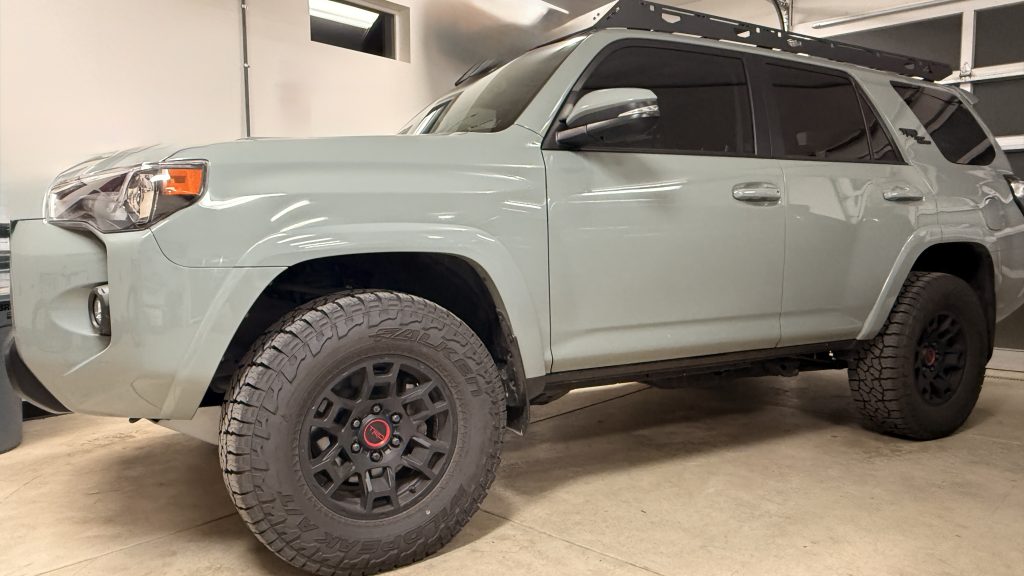
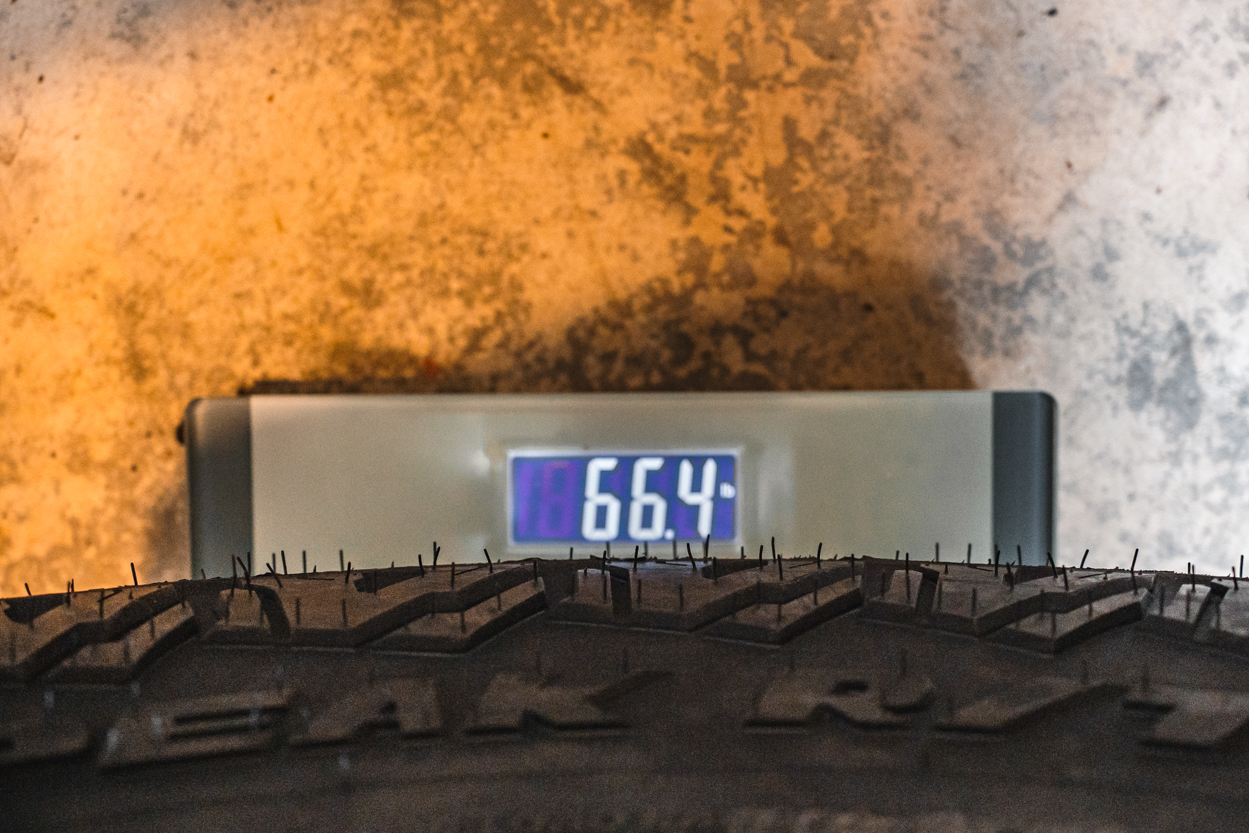
My 2023 Off-Road Premium 4Runner came stock with 265/70R17 tires; either Dunlop AT20s or Bridgestone Duelers. They weighed in at 40lbs each, and the OEM wheel weighs 31lbs each. The combined (approx) weight of this tire/wheel combo is 71lbs.
When I swapped my own wheels/tires, I went with a very well-known, extremely popular all-terrain tire in a larger 275/70R17 size on this TRD Pro Gen 2 wheel, which is flow-forged and weighs 22lbs. The combined (approx) weight of this tire/wheel combo is 72lbs.
Now, before the math police or hypocrisy enforcement unleashes and comes at me… I am fully aware this upgrade weighs more than stock, so let me explain. Going with this wheel/tire setup results in an almost indiscernible 1lb per corner weight increase, but a massive increase in traction and tire performance vs. stock. The 1lb of weight is also negated in the performance upgrade of having a new Bilstein shock above it. Also, the slightly larger tire looks badass (see, I’m guilty of wanting to look cool too).
The common occurrence I see over and over again is a leveled or lifted 4Runner with 285/70R17 tires or bigger, on XYZ-brand wheels, because they absolutely do look cool. They got their desired look, and that’s it. Rarely do you see this achieved with Flow-forged wheels and a lightweight tire.
Unsprung Weight
So why aren’t more people taking advantage of lighter-weight options? It’s a no-brainer. Cost is for sure a leading factor in the decision, and I get it. But as the saying goes, “Buy nice or buy twice”. And that’s never been truer than with 5th Gen wheel setups’ effects on suspension, because if you’re too far out of spec, it will start adding up, putting too much stress on CV-axles, control arms, steering boxes, etc.
Most people don’t “fully understand” the physics of unsprung weight. The best definition I found was:
“Unsprung Weight is the total weight of parts that are NOT supported by the vehicle’s suspension”.
This includes wheels, tires, brakes, hubs, control arms, axles, etc., and the more/if/when you can lower the weight of these components, the better the vehicle accelerates, brakes, handles, controls traction, and improves fuel economy. Unsprung Weight has long been well known in the racing community, and I think if more people understood the concept, more would seek to reduce the unsprung weight of their rigs where possible. The easiest way to do that is through tires and wheels.
Improving suspension performance has always been a massive motivator among all Toyota enthusiasts. Nothing improves suspension performance more than decreasing unsprung weight… it’s simple science.
Final Thoughts

I asked Ian how much weight reduction influences his wheel and tire design decisions. He told me that it’s never been a bigger issue than it is today.
“Everybody now asks about weight, when 3-5 years ago almost no one did. We have to have the weight listed online, and everyone else does too. I think it’s because now the manufacturing has gotten so good, it allows a product offering that is truly performance driven… and weight savings has always been a priority when it comes to performance.”
Then, I asked what he thought the best/ideal wheel/tire combo was for the 5th Gen 4Runner.
“In my opinion, in the simplest of terms, people would honestly feel the most legit upgrade in performance by going with a 275/70R17 tire and a Flow-Forged 17-inch wheel that’s anywhere from 7 to 8.5 inches wide. Anything bigger than that is out of spec for 5th Gen 4Runner… and to truly see an improvement with anything bigger than that, it would require re-gearing or some other mechanical upgrades to deal with the limitations of the 4.0 V6.”
Some naysayers may claim, ”So what. Big deal, I got a 4Runner to do truck stuff… if I wanted better handling or improved performance, I would have bought a sports car.” This statement isn’t wrong. But again, you are reading this because you’re a Toyota truck fan who clearly is interested in mods and performance. Wheels, tires, and suspension modifications are among the most common mods for Toyota folks.
So do yourself a favor, and be mindful with your mods, and just do it the right way, and not the cool way. Don’t be like me… don’t be a poser.
Thanks for reading. Be kind to yourself and others. The world needs more of it.

Absolutely 100% on point. I factored this in my plan to now run 37×13.50s r17. People ask me “how i made it possible with all that was done to my rig.” I always make a point to point my wheel choice, volk te37xt-m weighing around 18 lbs each, then factoring in tire weight. I have ran numerous tire sizes and truly believe that my wheel choice has saved me immensely. Mind you, im on STOCK gears as well, averaging around 14-14.5 mpgs. I ran methods and falkens at one point and it felt like i was driving concrete blocks.
Worthy read for sure. IG- chillonmedia
You’re on stock gears running 37’s and you get 14 mpg?
Do you happen to have the part number for the wheels? Looking at Toyota’s website they list the TRD Pro wheels as cast, not flow forged, so I’m wondering if I’m looking at the correct wheel. Thank you for the article, very good information.